The current problem
When an email conversation is shared with a third person—by CC’ing or BCC’ing them late in the thread, or by forwarding the conversation. The recipient often sees the entire history collapsed into a single email. The original messages are embedded as quoted text rather than delivered as separate emails, which prevents the email client from displaying the conversation as a properly threaded series of messages. As a result, the conversation becomes hard to scan and difficult to follow.
For example:
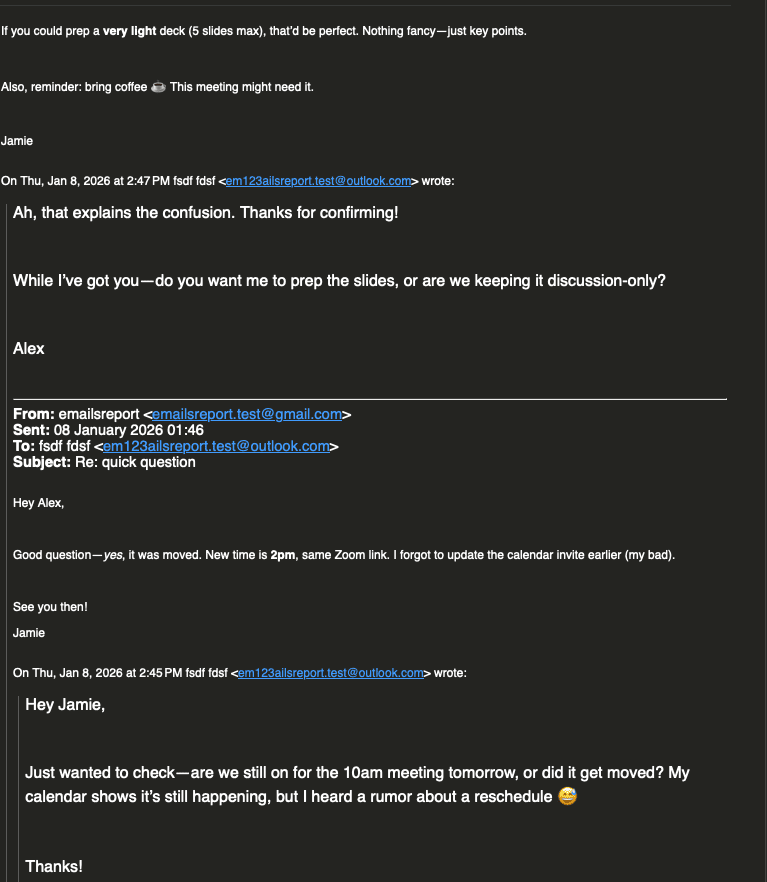
When an email conversation is collapsed into a single block of quoted text, it creates several practical problems:
-
Loss of readability Important context is buried inside nested quotes, making it hard to follow who said what and when.
-
High cognitive load Readers must manually scan sender names, timestamps, and indentation levels instead of relying on the email client’s normal conversation view.
-
Easy to misinterpret Replies can appear out of order, inline responses are hard to associate with the correct message, and key details may be missed.
-
Poor experience for external recipients People who were not part of the original conversation have the hardest time understanding it, especially in long or technical threads.
-
Inconsistent rendering across clients The same forwarded email may look acceptable in one client and nearly unreadable in another.
The explanation why the problem exists
Email clients can only display conversations as separate, well-structured messages when they receive each message as a real email with its original metadata intact. That metadata includes headers such as Message-ID, In-Reply-To, and References, which tell the email client how individual messages relate to each other.
When a third person is added to a conversation late (via CC or BCC), or when an existing conversation is forwarded, the earlier messages are not resent as individual emails. Instead, they are included inside the new email as quoted text. At that point, the original message structure is lost.
Although the quoted content may visually resemble multiple emails—with lines like “From”, “Date”, and “Subject”—to an email client this content is just plain text. The client cannot safely infer message boundaries or reconstruct the original conversation from the email body alone. As a result, it treats everything as a single message and displays the entire history as one stacked block.
Some email clients attempt to improve readability by collapsing quoted sections or detecting common reply patterns, but these are only visual heuristics. They do not restore true message separation, and small formatting differences can easily break them.
In short, once an email conversation is reduced to quoted text—whether by forwarding or late CC/BCC—email clients no longer have enough structural information to display the conversation as separate messages. This limitation is inherent to how email works and is consistent across Gmail, Outlook, Apple Mail, and other major clients.
how threading works vs. why it breaks
Case 1: CC added during the conversation (works)
Email 1: A → B
[Message-ID: 1]

Email 2: B → A
[Message-ID: 2]
[In-Reply-To: 1]

Email 3: A → B, CC: C
[Message-ID: 3]
[In-Reply-To: 2]

Recipient C receives:
 ├─ Email 1 (real message)
 ├─ Email 2 (real message)
 └─ Email 3 (real message)

Result in C’s email client:
✔ Messages are grouped
✔ Each message is shown separately
The client has all the headers it needs to rebuild the conversation.
Case 2: CC or BCC added late (does not work)
Email 1: A ↔ B
Email 2: B ↔ A
Email 3: A → B, CC: C

Recipient C receives:
 └─ Email 3 only
    └─ Email 2 (quoted text)
       └─ Email 1 (quoted text)

Result in C’s email client:
✖ Only one real message
✖ Previous emails are just quoted text
The client cannot split messages it never received as real emails.
Case 3: Forwarding a conversation (almost always fails)
Original thread:
 ├─ Email 1 [Message-ID: 1]
 ├─ Email 2 [Message-ID: 2]
 └─ Email 3 [Message-ID: 3]

Forwarded email to C:
 └─ New Email [Message-ID: 4]
    ├─ "From: A"
    ├─ "Date: …"
    ├─ "Subject: …"
    └─ (entire thread as quoted text)
The forwarded email contains only one Message-ID.
Everything else is content, not structure.
Result:
- One email
- One thread item
- Everything stacked together
Why email clients don’t “fix” this automatically
Email clients intentionally do not attempt to reconstruct message boundaries from quoted content. Parsing message structure from plain text or HTML would be unreliable and error-prone, and could easily misinterpret forwarded content.
Some clients apply visual heuristics—such as collapsing quoted sections or recognizing common reply markers—but these are only presentation tweaks. They do not restore true message separation.
This is where EmailsReport comes in.
EmailsReport solves this problem by acting as an intermediary. Instead of forwarding messy email chains, users can send the relevant emails to EmailsReport, which automatically rebuilds the conversation into a structured, readable format. Each message is clearly separated and labeled, making the conversation easy to follow.
The reformatted conversation can then be exported or copied as email-compatible HTML, ensuring it renders consistently across email clients and is suitable for sharing, documentation, or long-term archiving.
Check how to use EmailsReport App to transform email chains.